GreCon BOARDCONTROL
Contactless laboratory cut measurement by X-ray and laser technology
The GreCon laboratory cut measurement BOARDCONTROL offers a quick and precise measurement of the thickness and the mass per unit area of laboratory cuts.
BOARDCONTROL ensures a high product quality with simultaneous optimal use of material and energy. The use of the BOARDCONTROL focuses on the quick, precise and reproducible control of the most important panel parameters. The determined values are used as necessary proof of the panel quality and for product optimisation at the same time. If a too heavy panel is still acceptable for the end customer, this means too much material and production costs for the manufacturer, whereas a panel which is too light often shows only poor quality features.
Material distribution, thickness and density of the wood-based panels are checked by BOARDCONTROL. Thanks to accurate graphic and numerical displays, the operator is able to intervene specifically into the production process to achieve a uniform panel quality with a simultaneous optimal use of material and energy.

BENEFITS AT A GLANCE
MEASURING METHOD
Measurement is carried out stationary. Non-contact measuring sensors have to be fixed at a firm crossbeam. The laboratory cut to be measured is inserted into the movable sample frame and is transported automatically through the range of the measuring sensor. It is not necessary to distribute the samples or prepare them separately.
The X-ray source is provided below the material to record the measuring values; the high-precision sensor is above the material. The sensor detects more or less X-rays depending on the specific density and quantity of the measured material. This is the measure for the mass per unit area (kg/m²).
The thickness measurement works by means of triangulation. A laser beam is emitted onto the material surface and the camera mounted next to it monitors it. If the distance to the panel changes, there is a change of the monitoring angle and consequently a change of position of the image in the sensor. The distance to the measured material can be calculated based on the image position. The individual measured values result from offsetting the material thickness.
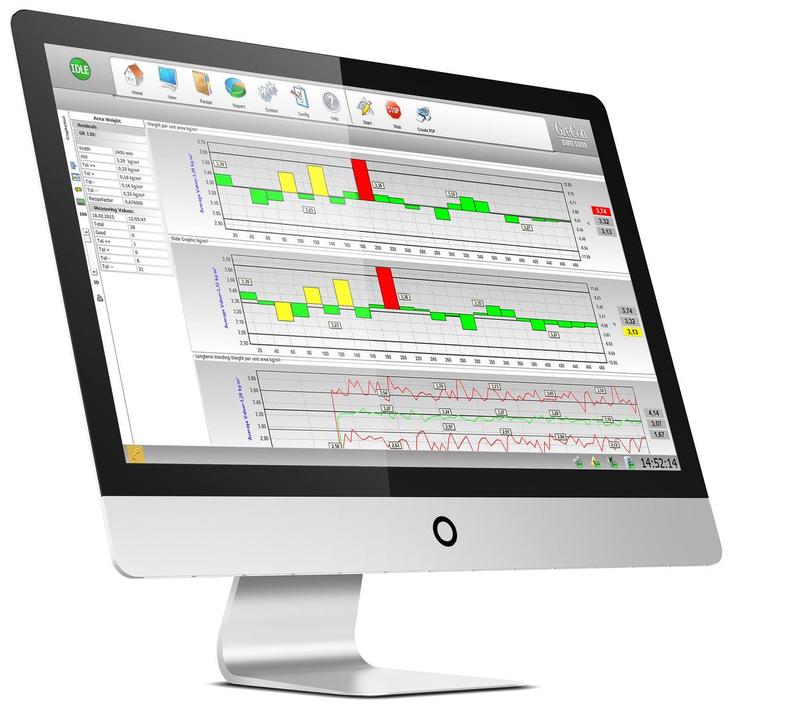
SOFTWARE FUNCTIONS AND VISUALISATION
AUTOMATIC CALIBRATION
The quality of the measured results mainly depends on the uniform conditions during the measuring process. Both measuring sensors are calibrated before each measurement to achieve high measurement accuracy.
For this purpose, a calibration sample is swivelled into the measuring range and an automatic calibration is carried out for both measuring sensors.
APPLICATION
TECHNICAL DATA